"Rising Sun" and "Devil's Stone". What else is the Senno District famous for?

Who invented the ornament?
In 2015, a memorial sign was erected on the central square of Senno in honor of Matryona Markevich, the author of the "Rising Sun" pattern, which was taken as the basis for the ornament on the State Flag of the Republic of Belarus.
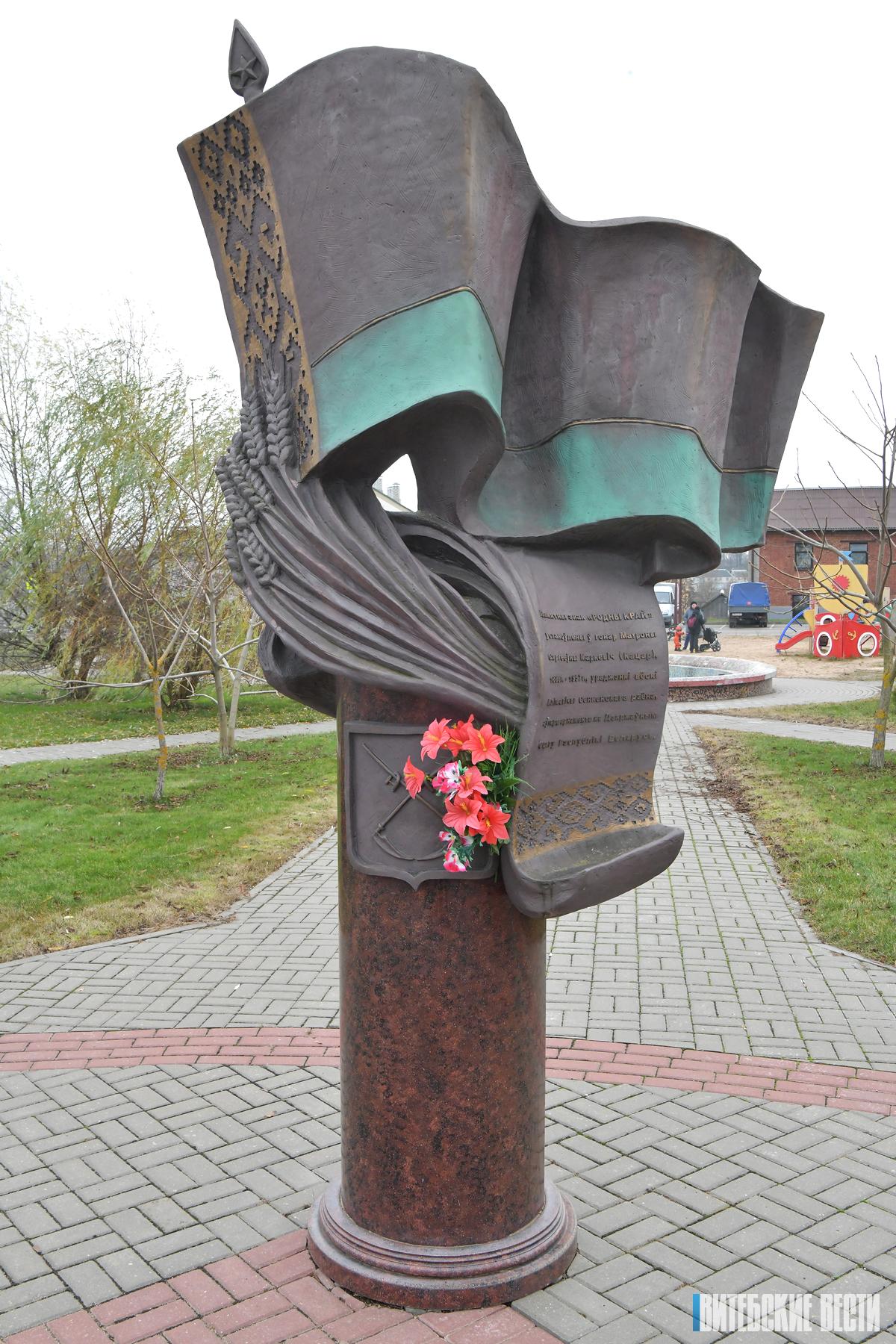
A native of the village of Klimovichi, she embroidered the memorable towel in 1917. Matryona Sergeyevna's brother, ethnographer and Doctor of Art History Mikhail Katsar, was invited in 1951 as an expert to the commission for the creation of the flag of the BSSR. There was a wish that the state symbolism should contain details that would reflect national characteristics. Mikhail Sergeyevich drew attention to the pattern of the ornamental motif "Rising Sun," embroidered on a towel by his sister and kept in the pre-war archive of Belpromsovet.
The elements of the ornament symbolize the "key to happiness," a wish for good development of events, prosperity, wealth, and the continuation of life.
One of Matryona Markevich's towels is kept in the district historical and local lore museum; its exact replica was made by masters of the Senno House of Crafts.
Solar Energy
More than two years ago, the first solar power plant "Polymya" with a capacity of 1.6 MW in the Vitebsk region began operating in Senno. The facility was named after the nearby agro-town "Polymya". It occupies an area of 3 hectares, which houses 132 tables with 4752 panels. Throughout the year, the plant can provide almost unlimited solar electricity to 900 apartments.

Healing Spring
The "Kaplichka" spring in Senno is one of the most accessible natural monuments in the Vitebsk region. You don't need to travel along field and forest roads to reach it – the spring is located in the city center.

The spring flows from a hill where an ancient pagan sanctuary was located, and it almost immediately flows into Lake Senno. The water has a characteristic smell of hydrogen sulfide. In addition to this element, it also contains selenium. It has a beneficial effect on the digestive system. In August, queues sometimes form here – a significant number of Senno residents and people from the surrounding areas salt cucumbers, always using water from "Kaplichka".
Local historian Vasily Bandarevich, in his book "Excursion to the Sources of Senno," notes that in 1802, the academician of the St. Petersburg Academy of Sciences, mineralogist and chemist Vasily Mikhailovich Severgin, mentioned "Kaplichka" in his records: "Near the mentioned house of the elder Serokovsky, behind the post yard, there is a well in a clay elevation, whose water has a liver-sulfur (hydrogen sulfide) smell, and it also loosens the bowels and eases the chest when two glasses are drunk in the morning."
In 1995, thanks to the district inspection of natural resources and environmental protection, as well as the builders of MPMK-64, the spring acquired its modern appearance. A rather large stone monument was built here. Thus, "Kaplichka" became one of the landmarks of Senno.
Voronin Boulder
The "Devil's Stone" ("Tailor") near the village of Voronino is the second largest in Belarus. The largest is also located in the Vitebsk region – near the village of Gorki in the Shumilino district.
.

According to research, this piece of grey-pink granite "slid" to us thousands of years ago with another glacier wave from the vicinity of the city of Vyborg, located near St. Petersburg. Its length is 10.2 m, width – 6 m, height – 4 m. The boulder has the status of a geological natural monument of republican significance and is protected by the state.
The "Devil's Stone" was considered the home of an evil spirit who was skilled in tailoring. According to legend, people would place canvas and money on the boulder, and the next day they would pick up the finished clothes. That's why it was also called "Tailor". The devil lived in the swamp under the stone, where a spring gushes, but often sat on the surface. In the middle of the boulder, there is even a recess resembling a peculiar chair. They say that if you sit in it, you can feel the imprints of scissors, needles, and coins on the right (though we couldn't find them). The local devil was distinguished by his good attitude towards people, especially the poor. But he disliked drunkards and often mocked men who rode from the tavern while intoxicated. He would lead them to the stone, and the poor fellow would think he had reached his own stove: he would undress and go to sleep.
It is unknown when "Tailor" sewed his last shirt or sheepskin coat. Perhaps it was by the time when the same men wanted to measure the bottom of the devil's swamp: they tied two huge poles together and began to poke into the mire. They never reached the bottom, but the owner of the stone, apparently offended that his dwelling was disturbed, closed his "atelier". According to another version, one day a woman asked the devil to sew something or other...
The boulder lies on the bank of the Abalyanka River. In this place, it is very winding and resembles a stream. Snake Hill is located not far from the stone. Legend has it that its name is associated with the following story. A serpent often appeared in the vicinity, stealing women and girls, and a devil quarreled with it. In the dark, the rivals regularly fought, once the duel lasted for three nights. When the devil got exhausted, he armed himself with a needle and hit the enemy in the eye. The serpent roared in pain, then the imp cut off its tongue with scissors. Soon the monster died, and the exhausted devil crawled to the stone, jumped into the quagmire, leaving a large column of water, and never appeared again. In the daytime, peasants came and saw the killed serpent. They were afraid to touch it and began to cover it with earth. Thus, a hill with characteristic outlines was formed, where many wild strawberries now grow in summer and from where wonderful local landscapes open up.
An alley of young pines leads to the "Devil's Stone". Local authorities have installed a gazebo here. According to Anatoly Baranovsky, the chairman of the Nemoytovsky rural council, the territory around the natural monument is maintained by employees of PS "Senno" UP "Zapad-Transnefteprodukt". People often come to the boulder, some leave donations in the form of Belarusian and Russian coins. The "Devil's Stone" is included in the developed tourist route Senno – Drutsk (Tolochinsky district).
Kupavat Zaslonova
The memorial complex "Kupavat", created on the site of a former village, is one of the significant objects of Sennensky district during the Great Patriotic War.

On November 14, 1942, during a punitive operation by the occupiers, the commander of the partisan formation Konstantin Zaslonov died here. Together with his comrades, he engaged in battle with superior enemy forces. After the war, his remains were reburied in Orsha.
The complex consists of the outlines of the foundations of former houses, a monument, and a mass grave where 52 Soviet soldiers and partisans are buried. A reconstruction of a partisan camp has been made with trenches, dugouts, a dugout shelter, a watchtower on a tree, a kitchen, and a dining room. This year, an information stand and a sign with a QR code have been added, through which one can obtain more detailed information about Konstantin Zaslonov and the activities of the partisans.
According to Oleg Barytko, the chairman of the Studzyonkaŭski village council, the complex is regularly visited by employees of the K. Zaslonov Orsha Locomotive Depot. Annually, students of the Orsha College, a branch of the Belarusian State University of Transport, make a tourist trip to this significant place. Many people who care about history come to Kupavata, which is far from major roads. Among the regular visitors are schoolchildren and residents of Sennenshchyna.
Glukharovskaya Whistle
The Glukharovskaya whistle, which has been granted the status of a historical and cultural value by the Ministry of Culture of Belarus, was revived by Ukrainian Vladimir Kvashko.
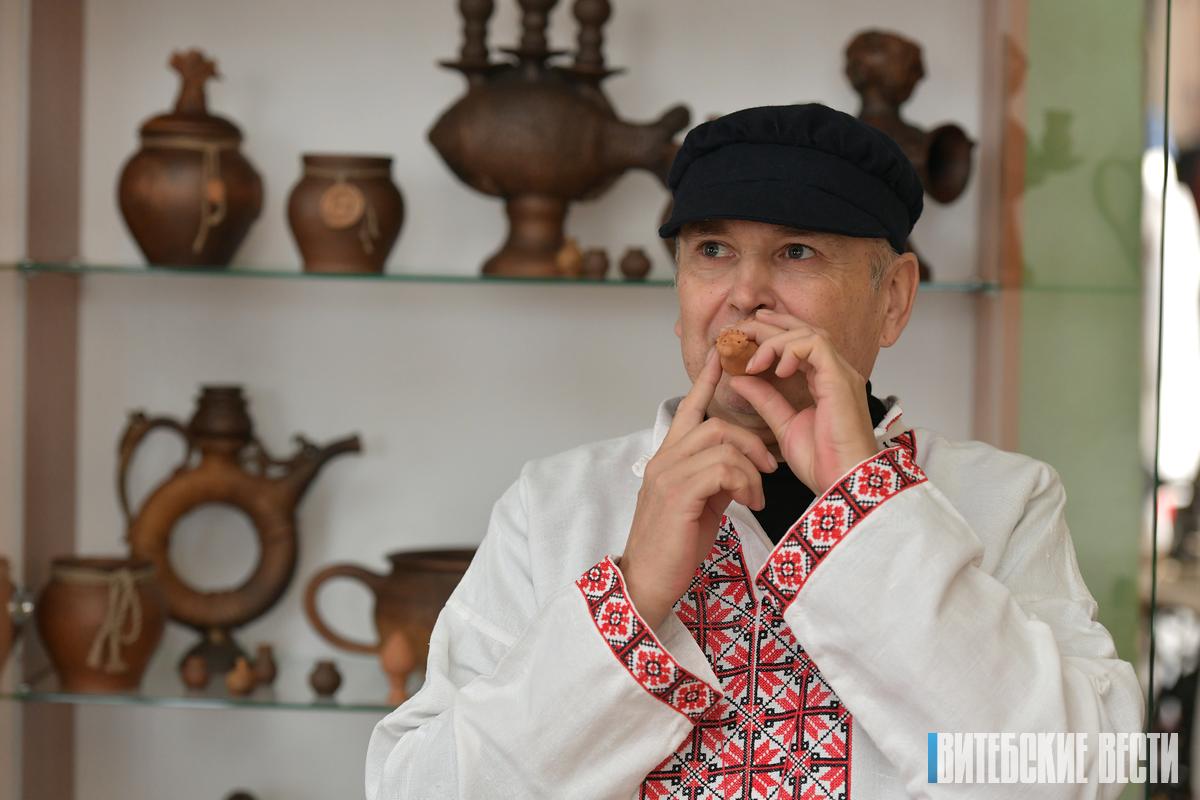
Vladimir Ivanovich is originally from the Sumy region of Ukraine, where he worked as an artist-decorator for the railway. In 2000, together with a friend, he became interested in ceramics and bought a potter's wheel. A year later, he came to Senno to visit his brother. He visited an exhibition at the House of Crafts to get acquainted with the experience of local masters. He stayed there, having met his destiny.
According to Olga Kvashko, the director of the Senno House of Crafts, the revival of the image and manufacturing technology of the Glukharovskaya whistle began in 2007 by master Inessa Saprinenka. Seven years later, Vladimir Kvashko took over the baton with the active support of Lyudmila Vakar, a leading methodologist of the regional methodological center for folk art. She personally knew Gennady Glukharov, a potter from the former brick factory of the Senno branch of the Vitebsk Production Association of Building Materials. A production leader in the 1980s, he participated in the Exhibition of Economic Achievements of the USSR and the All-Union Festival of Folk Art.
For three years in a row, Vladimir Kvashko presented his crafts for the jury of the "Soleyka" competition, held as part of the International Festival "Dnipro Voices in Dubroŭna". And all without success, the form did not yield. There were many worries, but the work continued. Finally, in 2017, competent specialists appreciated the simplicity and archaic nature of seven figures: two variants of a horse, a ram, a dog, a piglet, a lark, and a peacock. Vladimir Kvashko received the Grand Prix of the competition. Since then, the Glukharyevskaya whistle has begun a new life. Now it is known outside the region. For example, it was acquired by the Mogilev Regional Museum of Local Lore. Anyone can buy a clay toy that has been used as a ritual and magical tool since ancient times.
Towel of Unity
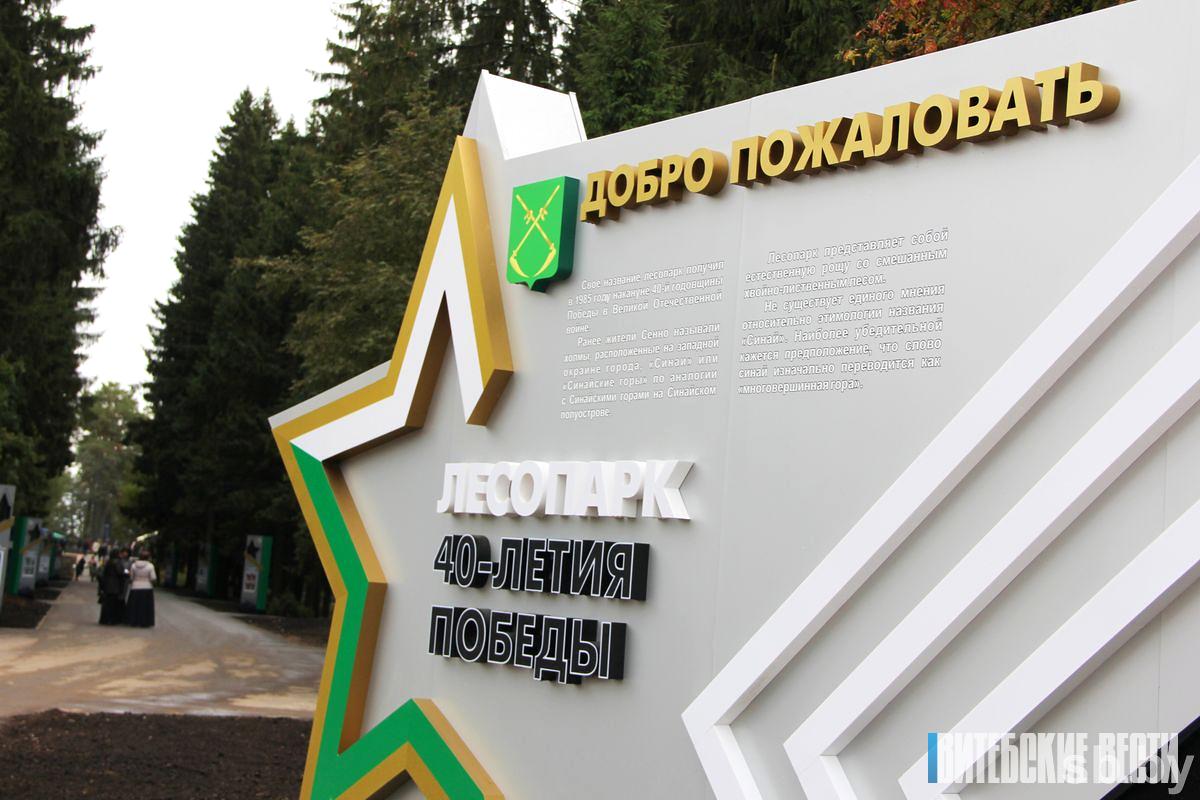
Last year, on National Unity Day, the renovated Park of the 40th Anniversary of Victory was opened in Sianno. The new locations have become additional points of attraction not only for local residents but also for city guests.

The park is designed for all types of recreation. The ski-roller track, where students of the Sianno biathlon school, famous throughout Belarus, hone their skills, has also been renovated.
It is noteworthy that the reconstruction took place when it was the 80th anniversary of the tank battle near Sianno. At the entrance to the forest park, eight pylons have been installed with information about the events that took place in the region during the Great Patriotic War. Including the Lepel counter-offensive in early July 1941, at the epicenter of which was Sianno region.
Assistance in the park's renovation was provided by "Vitebskablgaz", "Vitebskenergo", the Bogushevsk forestry and regional entrepreneurs joined in. Representatives of organizations and institutions made their contribution: people regularly participated in clean-up subbotniks.
On the day the park was opened, a five-meter towel was presented. It saw the light thanks to the "Let's weave the district's amulet together" campaign. In a few months, more than 500 people, from ordinary residents to regional leaders, laid their threads into the towel, which became a symbol of unity, solidarity, brotherhood, and hospitality.
This product, created through joint efforts, has become the youngest brand in the Sennensky district.